
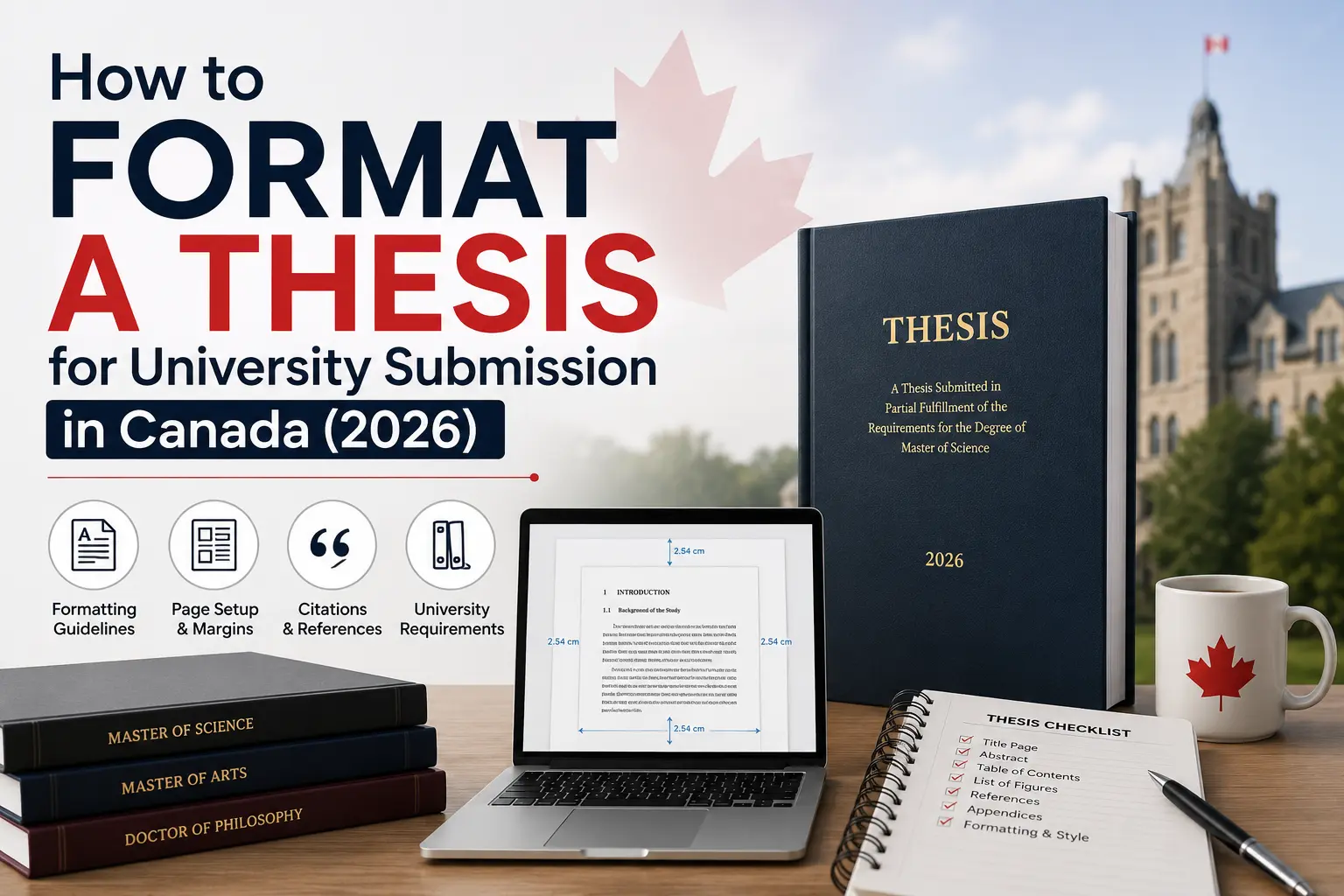
How to Format a Thesis for University Submission in Canada (2026)
Getting thesis formatting Canada universities require right is the final hurdle after finishing your thesis, and it’s often where small mistakes can delay approval or force last-minute revisions.
A lot of students spend a significant amount of time searching and writing their thesis only to discover that small formatting mistakes can delay approval or require last-minute revisions.
The margins you use and even the way you write your headings should be as per your university guidelines.
But formatting isn’t as challenging as it seems. Once you understand the basic requirements and check your university’s regulations, the process becomes much more manageable.
Keep reading to understand the key formatting elements Canadian universities commonly expect in 2026 and the areas students most often overlook.
What You Need To Know About Formatting Your Thesis
Take a look at this thesis formatting guide to know about the formatting areas that require your attention.
· Start with Your University’s Thesis Guide
Download your faculty’s official thesis formatting manual before changing fonts or adjusting page numbers.
Although Canadian universities follow many of the same academic standards, each institution has its own requirements for:
- Title page layout
- Preliminary pages
- Chapter formatting
- Citation style
- Margin sizes
- File submission requirements
For example, a thesis submitted to the University of Toronto may have different formatting expectations than one submitted to the University of Alberta.
Using another student’s thesis as your template isn’t always the safest approach because formatting requirements are updated regularly.
A lot of students also work with a thesis formatting service to meet these requirements.
· Choose a Professional Font
Most Canadian universities recommend simple and readable fonts throughout the paper.
Common options include:
- Times New Roman (12 pt)
- Arial (11 or 12 pt)
- Calibri (11 pt)
Decorative fonts may look appealing, but they’re unsuitable for academic work.
Make sure to use the chosen font consistently throughout the document unless your university gives any other thesis formatting requirements.
· Use Consistent Line Spacing
The main body of the thesis should usually be double-spaced or one-and-a-half-spaced unless your department provides different instructions.
However, certain sections often follow different rules.
The following items might require single spacing:
- Long quotations
- Footnotes
- Figure captions
- Tables
- Bibliography entries
Just remember that consistency matters a lot between them.
· Set Correct Margins
Margins aren’t just about appearance, as they also play a key role when you submit your work to dissertation binding services.
Many Canadian universities require 1 inch (2.54 cm) on all sides.
Some institutions ask for a slightly wider left margin to allow for binding.
Don’t waste your time trying to adjust margins manually throughout the document. Just set them once before you begin your final formatting review.
· Organize the Preliminary Pages Correctly
The order of the front matter is usually given a lot of importance in thesis formatting guidelines.
Although requirements vary slightly between universities, the preliminary pages often include:
- Title page
- Abstract
- Acknowledgements
- Dedication (optional)
- Table of contents
- List of tables
- List of figures
- List of abbreviations (if applicable)
These pages usually use lowercase Roman numerals before the main chapters begin, and the first chapter normally starts with Arabic page numbering.
Checking page numbering early can save you hours of corrections later.
· Apply Heading Styles Properly
Headings should create a clear structure that guides readers through your research.
You should use your word processor’s built-in heading styles instead of formatting each heading manually.
Doing so offers several advantages:
- Consistent formatting
- Automatic table of contents generation
- Easier navigation
- Simpler editing if styles need updating
If your university specifies heading levels, then you should follow those instructions throughout the document.
A consistent structure will make the thesis easier to read and give it a more polished appearance.
· Format Tables and Figures Carefully
Visuals such as charts and diagrams often strengthen academic research, but they also need consistent formatting.
A general rule for this university thesis format Canada is:
- Give tables and figures a clear, descriptive title
- Place captions consistently above or below, depending on your university’s guidelines
- Refer to every table or figure within the main text
Avoid inserting visuals without explaining why they’re important. Readers should understand how each one supports your research rather than having to interpret it on their own.
· Keep Your Citation Style Consistent
Whether your department requires APA, MLA, Chicago, IEEE, or another citation style, consistency is essential.
Common thesis formatting Canada issues include:
- Inconsistent reference entries
- Missing page numbers in citations
- Incorrect italics or punctuation
- Listing references in different formats
- Sources cited in the text but missing from the reference list
Reference management software can save time, but don’t assume it’s flawless. Review every citation before submission to ensure it matches your university’s requirements.
· Create a Clickable Table of Contents
Most Canadian universities now require electronic thesis submission, which means navigation matters just as much as appearance.
According to thesis publication services, using your word processor’s automatic table of contents allows readers and examiners to jump directly to chapters and sections.
It also updates page numbers automatically if changes are made during your final revisions.
Manually typing page numbers often leads to errors after edits, so it’s better to use built-in tools instead.
- Perform a Final Formatting Check
Set aside time to review the document solely for formatting once your writing is complete.
A useful checklist includes:
- Page numbers are correct throughout
- There is consistency in fonts and font sizes
- Margins match university requirements
- Headings follow the same style
- Tables and figures are numbered correctly
- Citations match the reference list
- Hyperlinks work properly in the PDF
- The table of contents updates correctly
- The final PDF displays as expected on different devices
Many formatting problems are small, but they become much easier to fix before submission when you learn how to format a thesis and review your paper with full focus.
FAQS
- Do all Canadian universities use the same thesis formatting requirements?
No. A lot of universities have the same academic standards, but the thesis formatting guide is different for each one of them. You should always follow your university’s most recent submission requirements.
- Should I convert my thesis to PDF before submitting it?
Yes. This is because Canadian universities often require a PDF version for electronic submission, as it saves formatting across different devices. Just make sure to review the PDF carefully before you choose to upload it.
- Can I use Microsoft Word templates for my thesis?
Yes, if your university provides an official template. Built-in Word templates can also help with headings and page layouts, but they should always be adjusted to match your institution’s formatting requirements instead of using them without any changes.
Key Takeaways
You have invested time in your research, and this is why a bad presentation should never be the reason your work quality gets questioned. Formatting may not be the most exciting part of writing a thesis, but it’s one of the final steps that demonstrates attention to detail and academic professionalism. So make sure to follow your university’s formatting guide to submit your work with full confidence.

Marc Hall has helped students in Canada to get their proper thesis and dissertation binding services. He understands the effort required to create each page, and he makes sure that all work receives excellent presentation. At Thesisbinding.ca, he has created informative articles and blog posts that guide readers through the entire binding process. Marc dedicates his free time to finding creative methods that will improve the thesis binding process for students by making it more efficient.