
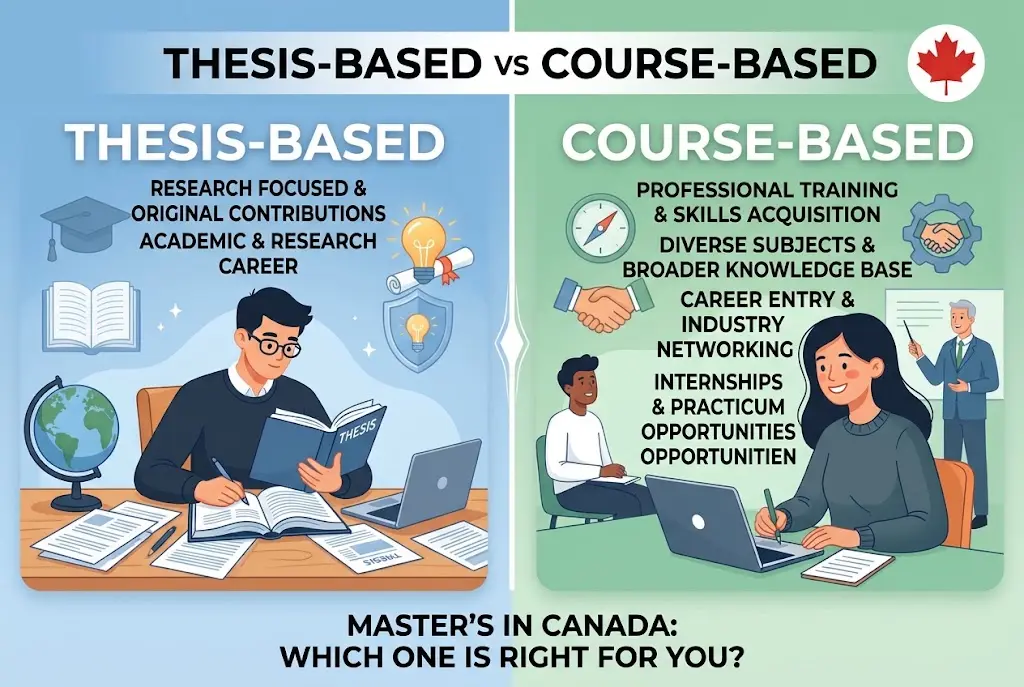
Thesis-Based vs. Course-Based Master’s: A Guide for Students in Canada
Choosing a master’s degree in Canada involves a very detailed thought process. Many graduate programs offer different study routes, with thesis-based and course-based master’s degrees being two of the most common options. Although both can lead to an advanced qualification, the experience can be quite different depending on how the program is structured.
A thesis-based master’s usually involves independent research and academic supervision, and a course-based master’s focuses on assignments and examinations. Choosing the suitable option depends on what you want to do after graduation and the way you prefer to learn.
Keep reading to figure out the pathway that will suit your academic objectives the best.
Everything You Need To Know Before Choosing A Master’s Degree in Canada
Understanding both options in detail before applying can make it easier for you to choose the one that fits your academic and professional plans.
What Is a Thesis-Based Master’s Degree?
A thesis-based master’s is a graduate program in which students complete advanced coursework alongside an independent research project.
The research normally results in a thesis, which is a substantial academic document that investigates a specific question or a topic within the student’s field.
Students work with a supervisor throughout the research process. The exact arrangement can differ between Canadian universities and departments, but the process can involve:
- Developing a research question
- The review of existing literature
- Selecting an appropriate methodology
- Collecting or analyzing information
- Interpretation of the results
After graduation, students who want to continue developing their research may consider turning part of their work into an academic article. Someone interested in this route may explore thesis journal publication as one possible way to prepare suitable research for an academic journal.
The research component is the defining feature of this type of degree.
- A student completing a master’s in environmental science might investigate the effect of a particular environmental factor on a local ecosystem.
- A student in education could examine a teaching method
- While someone studying computer science might develop and evaluate a new computational approach.
The thesis is not simply a long assignment. It is expected to demonstrate that the student can conduct academic research in a structured and independent way. The specific expectations depend on the university and discipline.
Students who expect to continue into a PhD often consider thesis-based programs because the research experience can provide preparation for doctoral-level study. But continuing PhD-level studies is optional and totally depends on the students after the thesis is completed.
You can also choose the research route just because you are interested in it.
What Is a Course-Based Master’s Degree?
A course-based master’s places strong emphasis on structured learning through classes instead of working on a major independent research thesis.
Students normally complete a set number of graduate courses, which may include:
- Lectures
- Seminars
- Group projects
- Presentations
- Written assignments
- Examinations
Students may also complete a capstone project, internship, practicum or major applied assignment depending on their program.
The exact structure can be different across Canada. Some programs are designed around professional practice, while others combine academic coursework with practical projects.
For example,
- A course-based master’s in business may include subjects such as finance, strategy, marketing and organizational management.
- A technology program could focus on data analytics, software development, cybersecurity or project management.
The learning in mostly applied through practical projects instead of conducting a long-term research study.
This structure can be appealing to students who:
- Prefer a defined curriculum and regular academic deadlines
- They like to work through several subjects with clearly established learning objectives instead of developing one large research question over an extended period
- Already know the type of professional role they want to pursue
But remember that course-based does not mean that the program is necessarily easier. Graduate courses can involve demanding reading, assignments, presentations, examinations and group work. The workload is simply distributed differently from a thesis-based program.
Key Differences
The biggest difference between the two routes is already mentioned above (how the degree is completed) but several other factors can influence the decision.
1. Structure
| Thesis-Based Masters | Course-Based Masters |
| A thesis-based program combines coursework with a substantial independent research project | A course-based program follows a more structured curriculum |
| Students generally have more flexibility in shaping their research topic, but their work must fit within the department’s academic requirements and available supervision | Some programs allow electives, but the overall academic path is generally more predictable for students. |
2. Workload
Neither route should be viewed simply as easier or harder. The workload takes different forms.
| Thesis-Based Masters | Course-Based Masters |
| Thesis students may spend a lot of time reading academic literature, designing research methods, gathering data, analyzing findings and revising their thesis. | Several assignments and exams may overlap during busy periods, particularly toward the end of a term |
| Someone who likes working independently on a long-term project may find the thesis structure comfortable | Someone who prefers shorter assignments and clear deadlines may prefer coursework |
3. Academic Independence
Another important difference is the amount of control students have over their work.
| Thesis-Based Masters | Course-Based Masters |
| Students can make many decisions about the research | These programs generally provide more guidance |
| They may need to narrow a broad topic, determine a research method, organize evidence and respond to feedback from their supervisor | Students will get established syllabus, assessment criteria and course schedules |
Thesis-based masters also offer students the freedom to decide on thesis binding after completing their final submission for physical copies, depending on their university’s requirements and personal preference.
4. Research Component
| Thesis-Based Masters | Course-Based Masters |
| Research is central to a thesis-based master’s. Students are expected to develop a research question and contribute a focused investigation within their field | Course-based programs may still include research. Students might analyze published studies, complete research-based assignments or conduct an applied project |
The difference is that research is generally not the central requirement of the entire degree.
This distinction matters if you are considering doctoral study. A thesis-based master’s can provide more direct experience with research methods and working with a supervisor.
5. Career Paths
| Thesis-Based Masters | Course-Based Masters |
| A thesis-based degree can be useful for students interested in research-intensive careers, and further graduate study | Course-based master’s degrees can be useful for students who want to strengthen professional or technical skills |
| It can also be relevant to professional roles where research or specialist knowledge is important | Graduates may move into management, consulting, technology, education, public administration, healthcare, business or other professional fields |
That does not mean graduates from one route are limited to certain careers. Employers generally consider the whole profile, including the student’s skills, previous experience, internships, projects and professional background.
6. Cost and Time
| Thesis-Based Masters | Course-Based Masters |
| A thesis-based program can include some courses but it requires a lot of research time | A course-based program may have more courses, whereas some professional master’s programs are intentionally designed to be completed within a set period |
All the students should compare the actual program requirements. This is much better than assuming that the thesis option will be cheaper or that the course-based route will always be faster.
You can also check if funding opportunities are available. Some thesis-based programs can offer research-related funding. But remember that availability can differ by university and department.
This is why funding should be confirmed directly with the institution.
Which One Is Right for You?
The right choice for most of the students will depend largely on your plans after graduation.
- Start with your career goals
A thesis-based master’s:
- Can give you experience that is relevant to your goals if you are considering a PhD and a research position
- Helps you develop research skills, learn how to work with academic literature and complete a substantial independent project
A course-based program may fit your plans more closely if:
- The main goal is to gain advanced professional knowledge and move into or progress within a specific industry
- You are searching for a program that offers courses that match the skills employers in your target field value
- Think about your interest in research
- Do you enjoy asking detailed questions and spending weeks or months investigating one topic?
- Are you comfortable reading academic papers and dealing with results that do not always follow your original expectations?
A thesis may be a natural fit if the answer is yes,
Coursework may feel more suitable if you prefer variety and would study several subjects instead of spending a large portion of your degree investigating one research question.
- Your preferred timeline should also be considered
- A thesis can involve uncertainty because research does not always progress as planned. Data collection can take longer than expected or a research question may need to be adjusted.
- A course-based program generally provides a clearer schedule because classes, assignments and examinations are planned in advance.
So before making a decision, you should ask yourself:
- Do I want to pursue a PhD or research-based career?
- Am I really interested in conducting independent research?
- Do I prefer one large project or multiple smaller academic projects?
- Would a structured course schedule help me stay on track?
- Does my dream career value research experience?
- How much time can I realistically dedicate to an extended research project?
- What are the actual funding and completion requirements of the programs I am comparing?
It is also important to look beyond the degree title. Two master’s programs with similar names can have very different requirements. Read the program handbook, check the course list, review the thesis requirements and identify potential supervisors if you are considering the research route.
What Happens After You Choose the Thesis-Based Route?
Choosing a thesis-based master’s does not mean you immediately begin writing hundreds of pages. There is usually a progression from coursework and topic development to research, analysis and final submission.
Here is a quick overview of the next steps.
- The First Stage
It often involves identifying an area of interest and discussing possible research topics with a supervisor.
- Second Step
Your chosen topic may then be narrowed into a specific research question that can realistically be investigated within the program’s timeframe.
- Third Step
Students will have to conduct a literature review to understand what has already been published about the subject. This stage can help in knowing about existing research gaps and help establish why the proposed study deserves to be conducted.
- Fourth Step
The next steps depend on the discipline. A project may involve interviews, surveys, laboratory experiments, or another methodology.
- Fifth Step
Students analyze the findings and begin developing their thesis once the research is complete.
- Sixth Step
The writing process usually involves several rounds of feedback and revision rather than producing a final document in one attempt.
Students who need help improving the clarity and organization of their academic work may seek thesis writing & editing support, provided that the learning process is not compromised.
FAQS
- Is a thesis-based master’s better for a PhD?
A thesis-based master’s can provide research experience for students who are considering doctoral study, but admission requirements differ between PhD programs. Students should check the requirements of the doctoral programs they might apply to in the future.
- Can I get a job with a course-based master’s?
Yes. Course-based master’s degrees are commonly designed to develop advanced academic, professional and technical knowledge. The career outcomes will depend on the specific program, industry, work experience and skills of the graduate.
- Is a thesis-based master’s harder than a course-based master’s?
Not necessarily. The two routes offer different types of workload. A thesis involves sustained independent research, while a course-based degree can involve multiple assignments, projects and examinations throughout the program.
- Can I switch from a course-based master’s to a thesis-based program?
It may be possible, but it depends on the policies of the institution and program. Students should check the program regulations and speak with the graduate department before assuming that a transfer is available.
- How long does a master’s degree take in Canada?
The duration will depend on the university and study format. Some master’s degrees can be completed in around one to two years of full-time study, while research requirements or part-time study can take more time.
Final Word
The decision between a thesis-based and course-based master’s will always be connected to what you want the degree to help you achieve. Looking carefully at the program structure, career relevance, research expectations, funding options and your own working preferences can make the choice much clearer.

Marc Hall has helped students in Canada to get their proper thesis and dissertation binding services. He understands the effort required to create each page, and he makes sure that all work receives excellent presentation. At Thesisbinding.ca, he has created informative articles and blog posts that guide readers through the entire binding process. Marc dedicates his free time to finding creative methods that will improve the thesis binding process for students by making it more efficient.