
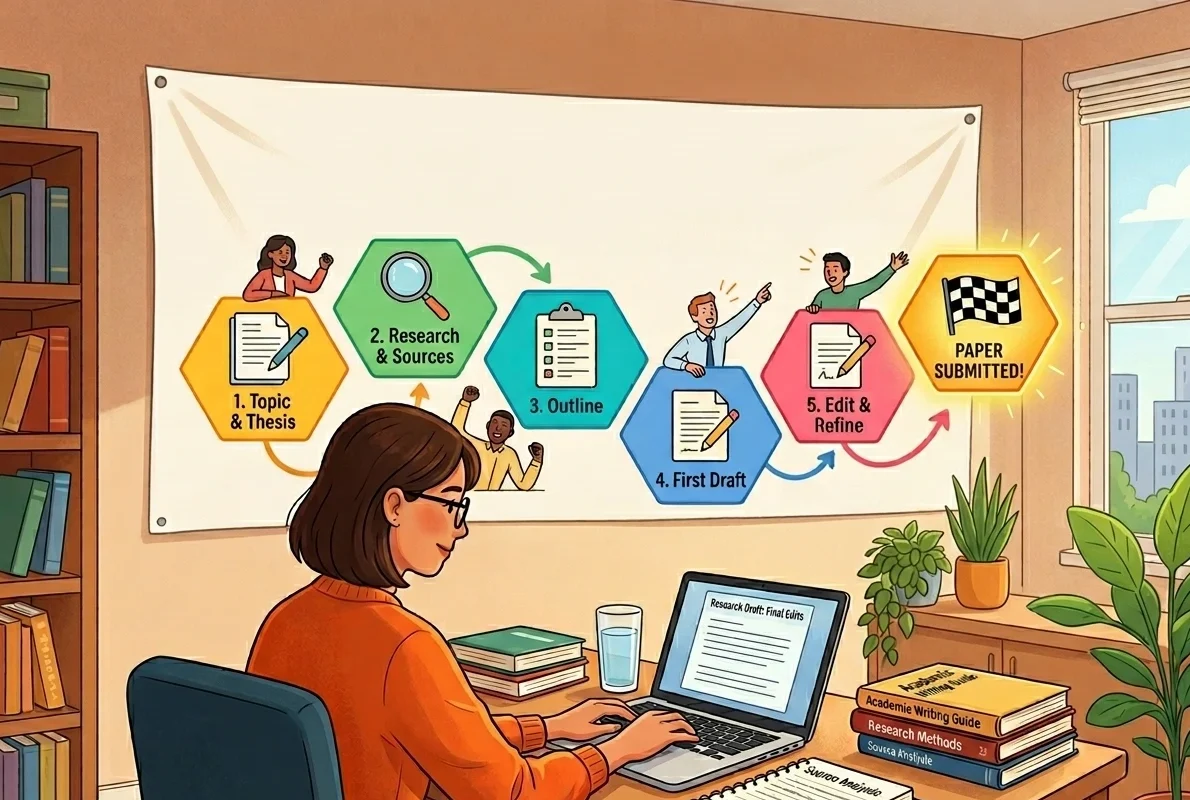
How to Write a Research Paper Without Stress
Learning how to write a research paper is one of the most common challenges students face, and finishing it is an entirely different battle. Nobody tells you that writing a research paper isn’t actually the hard part. The hard part is sitting down without a clear sense of what comes next, so you stare at a blank document, open seventeen browser tabs, and convince yourself you’re not ready yet.
The paper isn’t the problem. The process is.
This guide won’t tell you to “believe in yourself” or “break it into small steps” without explaining what those steps actually are. It’s a straight walkthrough, from picking your question to submitting your final draft, so you can stop dreading it and start moving.
Not sure what to write about yet? Check out our list of research topics for students first.
Pick a Question, Not a Topic
“Climate change” is a topic. “Does remote work reduce carbon emissions for urban employees?” is a question, and that question is a research paper waiting to happen.
When you start with a topic, you have no destination. You collect information without knowing what you’re trying to prove or explore. That’s where the overwhelm starts.
A question forces direction. It tells you what to look for, what to ignore, and when you have enough. It also becomes the backbone of your thesis statement later, so you’re not building that from scratch either.
To narrow it down: take your broad topic, ask “what specifically do I want to know about this,” and keep asking until the answer fits one clear sentence. That sentence is your starting point.
Do Enough Research, Not All of It
Most students don’t struggle with finding sources. They struggle with stopping.
You open one article, it links to another, that one references three more, and two hours later, you’re reading a 2019 study that has nothing to do with your question. This is how timelines die.
Research with a limit, not a mood. Before you start, decide:
- How many sources do you actually need? For most papers, 8 to 12 solid sources beat 30 weak ones.
- Where you’re looking: Google Scholar, JSTOR, PubMed, or your university database. Skip blogs and random websites unless your paper specifically calls for them.
- When you’ll stop: Once you can argue your point from multiple angles, you have enough.
One habit that saves hours: as you go, drop every useful quote or stat into a single document with the source link next to it. No scrambling later when you’re writing and can’t remember where you read something.
Research isn’t the paper. It’s the material. Treat it that way.
Write the Draft — Don’t Edit It Yet
The most common reason a research paper takes three weeks longer than it should is that people edit while they write. Some look for a thesis editing service as well, which is a time-saving option.
You type a sentence, hate it, rewrite it, hate it again, delete it, and end up with the same blank page you started with. That’s not writing. That’s self-sabotage dressed up as perfectionism.
Your first draft is not supposed to be good. It’s supposed to exist.
Start anywhere, not necessarily the introduction. If the methodology section feels clearer right now, write that first. If you know exactly how you want to end, write the conclusion. The structure can be fixed later. What can’t be fixed is a page that’s still empty.
Turn off the internal editor for one session. Get the ideas out in whatever shape they come. Messy, incomplete, repetitive doesn’t matter. You can only fix something that’s written down.
How to Revise Without Missing Your Own Mistakes
After you finish a draft, don’t touch it for at least a day.
This sounds like wasted time. It isn’t. When you’ve been staring at the same paper for weeks, your brain autocorrects your own mistakes. You read what you meant to write, not what’s actually there. Distance fixes that.
Come back with a specific checklist: Does each paragraph support your argument? Are your citations consistent? Does the tone stay academic throughout without reading like a textbook?
Some things you can catch yourself. Other awkward phrasing, structural gaps, and citation formatting errors are genuinely hard to spot in your own work. That’s when professional support from a writer or an editor makes a practical difference. Not because your writing is bad, but because a trained editor reads your paper the way your examiner will, and flags what you’d otherwise miss two days before submission.
Fix what you can. Get help with the rest.
Format and Submit Without the Last-Minute Panic
Most students treat formatting as an afterthought. Then they spend the final night fixing margins, chasing citation errors, and realizing their university wants something they’ve never heard of. Don’t be that person.
Before you submit, confirm:
- Which style guide does your department require, APA, MLA, Chicago, or Harvard
- Margin sizes, font, line spacing, and page numbering as per your university’s official guidelines
- That your references section matches your in-text citations exactly
One thing most students find out too late
Many universities still require physically bound copies alongside digital submission. Hardcover thesis binding is the standard for final submissions at most institutions. And binding services typically take 3 to 10 business days. Factor that into your timeline before you’re scrambling the week of your deadline.
Check everything twice. Submit once.
FAQs:
Q: How long does it take to write a research paper?
A: Most students finish in 1 to 2 weeks with a clear process topic, research, outline, draft, and revision handled separately rather than all at once.
Q: When should I use a thesis editing service?
A: After your draft is done. It’s most useful for catching tone issues, citation errors, and structural gaps that are hard to spot in your own writing.
Q: What is thesis binding, and do I always need it?
A: It’s the physical binding of your printed paper for university submission. Many universities still require bound copies alongside digital files. Check your department guidelines early so it doesn’t catch you off guard.
One Step at a Time
The paper you’ve been avoiding isn’t waiting for you to feel ready. It’s waiting for you to pick a question, open a document, and write one bad sentence that you’ll fix later.
Every researcher you’ve ever cited started exactly where you are right now.
You don’t need a perfect plan. You need a starting point and enough stubbornness to keep going when it gets uncomfortable. The process in this guide exists so you spend less time staring and more time actually writing.

Marc Hall has helped students in Canada to get their proper thesis and dissertation binding services. He understands the effort required to create each page, and he makes sure that all work receives excellent presentation. At Thesisbinding.ca, he has created informative articles and blog posts that guide readers through the entire binding process. Marc dedicates his free time to finding creative methods that will improve the thesis binding process for students by making it more efficient.