
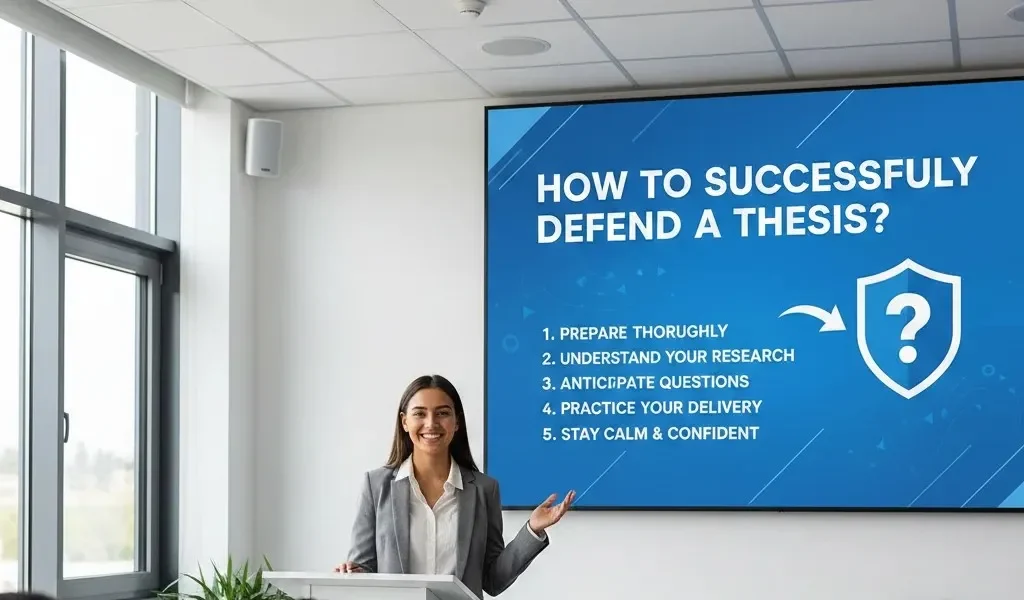
How To Successfully Defend A Thesis?
It’s that time of the year! The thesis defense is approaching. You give your nights and endless efforts to your research. You write down your thesis without missing any detail. But the real deal is when you are presenting your thesis to a committee. This oral examination is one of the most stressful moments in the academic years of any student’s life. But hey, honestly speaking, after all the struggling of framing a proper research work, the thesis defense is not much of a big deal. By following the right steps and letting out your inner confident human being, you can totally ace this part.
What is a Thesis Defense? An Overview!
You spent days, weeks, months, or maybe years writing your thesis. Now, a room full of experts wants to ask you a question about it. That’s exactly what the thesis defense is. You present your thesis, explain why you participated in it, and prove the findings you get from your work. It is a formal academic conversation, including your thesis supervisor and some experts from the same field, comes to interrogate you. This process is not designed to destroy you. But it is made to assess whether you understand your work or not. And, yes, it sounds scary to stand in front of experts and be asked unplanned questions. But it is not impossible. With correct preparation, you can perform well in this formal conversation. You just need to make a proper PowerPoint file and must consider taking help with the thesis for any queries or confusion you are facing. In most of the cases, the committee usually wants you to pass. They have seen your work evolve, approved. All they want is to evaluate how far your mind can think about the topic you are presenting.
Steps To Follow When Preparing for the Thesis Defense
How Early Preparations For Thesis Defense Make the Whole Process Go Smoothly?
If you are planning to prepare for this critical phase a night or two before the day, then you are asking for chaos. There is no doubt a risk to begin planning this late. It might ended up messing the whole situation. Nobody wants their months of hardwork go in vain. So why not start the whole preparation phase a little earlier? In this case, you will have enough time to manage any mishaps that could occur. The goal is not to memorize your whole thesis word for word. It is about being confident in talking about it without constantly needing to look at the notes. It creates a negative impression on the examiner, and they perceive the situation as an unprepared measure. Start revising your thesis 3-4 weeks prior. Make the presentation by aligning each heading in a uniform manner. Practice answering the questions out loud, and you will definitely end up preparing for the whole defense perfectly. Also, a little thesis help could always come in handy.
Be Prepared To Defend, Not Just Describe
You need to figure out one thing. There is no need to know everything. More simply, you need to sort out the possible reasons and facts regarding your topic. Figure out why your research matters. Do the complete background check, but avoid going intio rabbits holes. Only search on the part that connects you with your thesis. Consider collecting questions about methodology, your findings, how that research is impacting, what the limitations are, and how your work fits in your field. It is not mandatory to memorize every equation or citation. You can not answer every question perfectly. The committee offers this much margin to the candidate.
Put Your Best Efforts into Making a Defense Presentation
Okay! So, let’s get this straight. You are standing in the room with all the committee members. They are there to evaluate you. And one look at the presentation, and it is already boring them. This whole scenario looks nothing less than a nightmare. Your PowerPoint skills should shine when you are presenting your hardwork infront of them. If it bores them already than you probably start expecting that your research is not going for thesis binding Canada. But let’s get to the positive part, which is how you can make an exceptional document. A solid structure mainly contains,
- Introduction & research problem
- Why this topic matters
- Literature overview (brief)
- Methodology
- Key results
- Discussion & implications
- Limitations and future work
Don’t add too much text. Your examiner does not want to read the paragraphs. Keep it minimal, concise, straightforward, and to the point.
These are some basic guides to a remarkable performance in your thesis defense. If you remain on track, we ensure that you will shine in the room and definitely get good remarks.
What Kind Of Questions Are Usually Asked In The Thesis Defense?
This is the most asked about query from the students. It makes them the most nervous and sometimes drains their confidence completely. They present their defense strongly, but the moment the jury member starts asking the questions, the candidate usually messes it up even though they know the answers well. First, you boost your confidence. Try speaking slowly. Pause before answering any question. They do not expect you to be flawless. They expect you to be thoughtful. Then comes the question part. Keep one thing in mind. The committee member will only ask you the questions regarding your topic like why this topic, what limitations are, how it impact in your field, and so on. Sometimes they asked the questions that they do not even know the answer to just to observe your response. If you do not know the answer, don’t panic or do not fake it. Be honest and say whatever is on your mind.
Prepare Yourself For the Next Step
If you are thinking that you are done after the thesis defense, then you are a bit wrong. It might be possible that the jury members would have suggested some editing in your proposal. It is quite rare that there is a fail or die moment in your defense trial. After the editing, send your thesis for publication. Ask for help from the best journal publication service near me and ensure your thesis does not lack any points before publication.
FAQs
Can I bring my notes to the defense thesis?
Usually, you can bring one. But avoid continuously reading from them and do not completely rely on them.
How long should the defense presentation be?
It actually depends on your institution’s parameters. Typically, the presentation time is 20-45 minutes. Ensure to check the guidelines before.
What if my committee disagrees with me?
Disagreement is not failure. An academic and respectful disagreement is a chance to polish your work.
Is it necessary to add everything to my defense presentation?
Absolutely not! Add the pointers in your presentation. Avoid including any long paragraphs and keep the content to the point.
Prove Your Honesty and Intellectual Maturity
You can not expect yourself to have an encyclopedic memory. There are times when your imperfections peek through your confident, strong personality, and it is completely fine. The definition of perfection is how you reach there by correcting yourself at the points where you were weakest. A thesis defense is about proving that you have grown into an adult researcher who has the capability to think, learn, explain, and reflect.